Taiwan Intellectual Property Survey Report 2025

Taiwan Intellectual Property Survey Report 2025
2026/06/18
Since 2013, the Innovation & Intellectual Property Center at the Science & Technology Law Institute, Institute for Information Industry (III), has conducted biennial surveys on intellectual property (IP) management among Taiwanese listed firms. The 2025 survey collected valid responses from 339 listed companies and reveals a marked transition from task-based IP operations toward institutionalized and governance-oriented frameworks. This paper analyzes key developments, including the increasing professionalization of IP human resources, growing strategic reliance on trade secrets, industry-differentiated patterns of IP commercialization, and emerging challenges driven by ESG-related governance requirements. The study concludes with policy recommendations aimed at strengthening corporate IP governance and supporting firms’ capacity to integrate IP management into broader sustainability and competitiveness strategies.
1. Introduction
Intellectual property has become a strategic component of corporate competitiveness, risk management, and sustainability reporting. As global regulatory environments evolve and supply-chain cooperation expands, firms face the dual pressure of safeguarding intangible assets and demonstrating governance capability. The 2025 IP Survey provides new insights into how Taiwanese listed firms are responding to these challenges. Compared with previous survey cycles, the 2025 results indicate a clear shift toward institutionalized IP governance, increasing resource allocation, and heightened awareness of trade secret risks.
2. Institutionalization, Professionalization, and Transparency of Corporate IP Management
2.1 Professionalization of IP human resources
78% of surveyed firms report having dedicated IP personnel or departments, and among these, 36% operate standalone IP units. The information technology (IT) industry shows the highest level of maturity, with 45% maintaining dedicated IP departments and 11% operating mid-sized IP teams (4–6 professionals). In contrast, the manufacturing and healthcare/consumer industries continue to rely more heavily on part-time or cross-departmental arrangements.
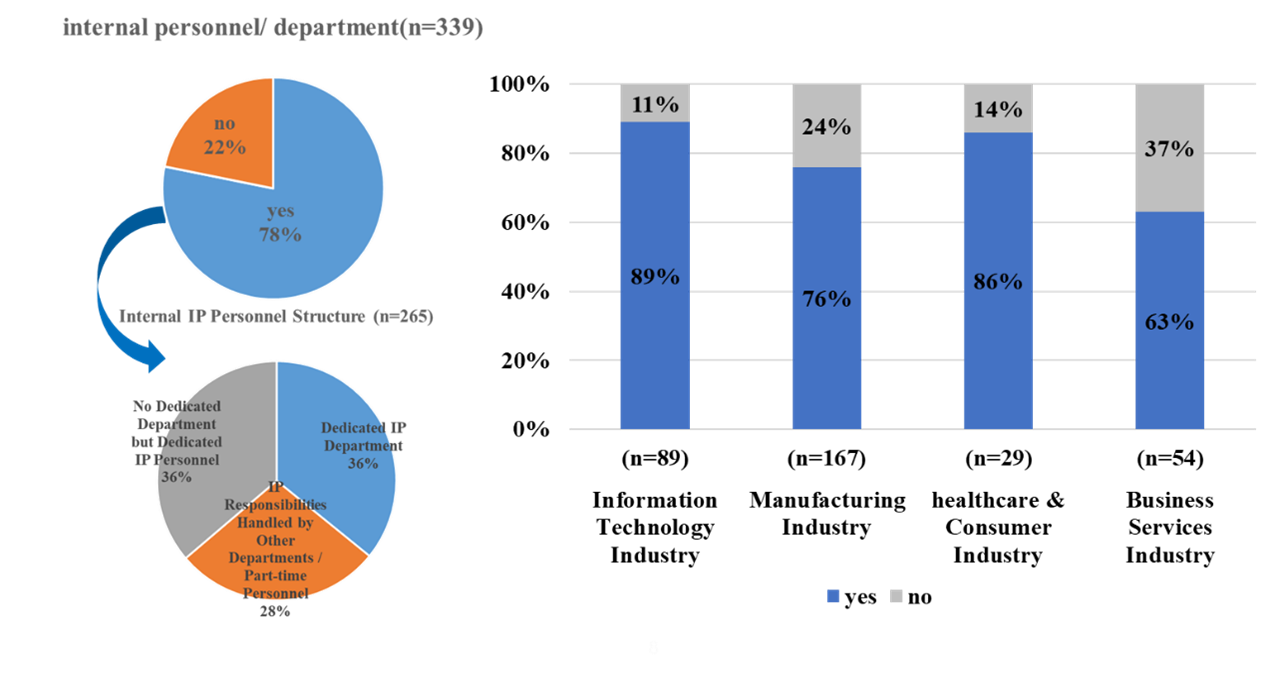
Data source: Innovation & Intellectual Property Center, Science & Technology Law Institute (STLI), Taiwan Intellectual Property Survey Report 2025.
Fig. 1 Professionalization of IP human resources
2.2 Acceleration of procedural institutionalization
Among surveyed firms with IP personnel, 93% perform foundational IP processes, such as acquisition and administration. Extrapolated to the full sample, approximately 73% of all surveyed firms actively operate such processes. Additionally, roughly 80% of firms with IP personnel have established internal IP management system and IP transactions and exploitation, equivalent to about 62% of all surveyed firms.
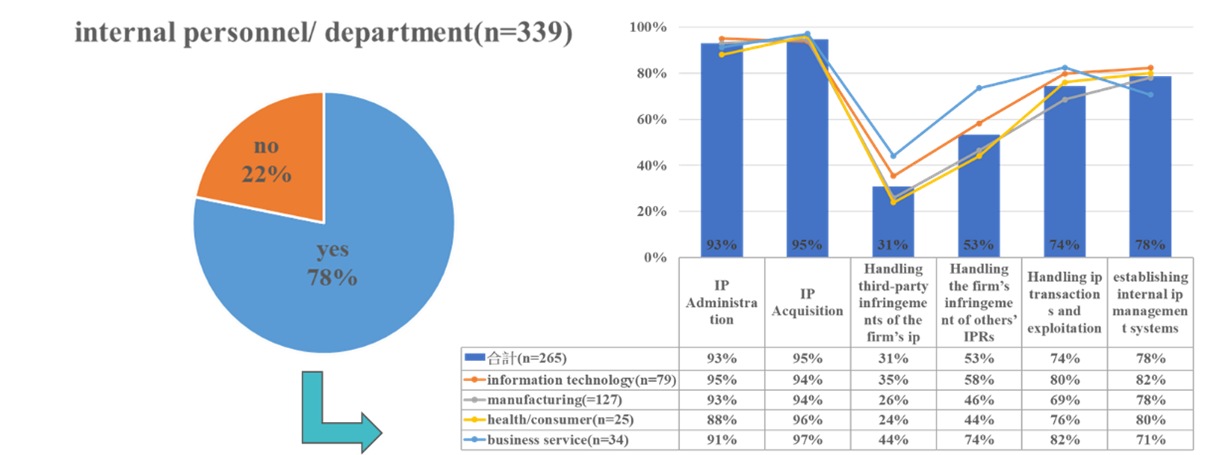
Data source: Innovation & Intellectual Property Center, Science & Technology Law Institute (STLI), Taiwan Intellectual Property Survey Report 2025.
Fig. 2 Internal personnel/ department tasks
71% of surveyed firms invest financial resources in intellectual property, with the Healthcare/customer Industry (79%) and the Information Technology Industry (78%) showing the highest levels of engagement. In addition, 60% of surveyed firms provide intellectual property education and training, primarily covering fundamental IP concepts (50%) and trade secret management systems (33%), indicating that companies are strengthening organization-wide IP literacy.
>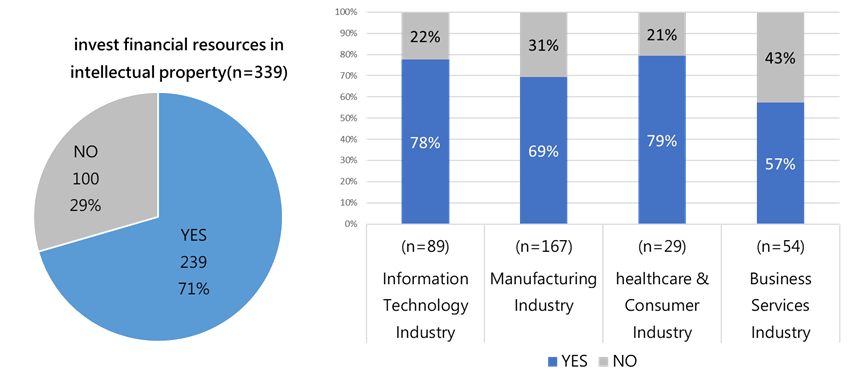
Data source: Innovation & Intellectual Property Center, Science & Technology Law Institute (STLI), Taiwan Intellectual Property Survey Report 2025.
Fig. 3 firms invest financial resources in intellectual property
3. Limited but increasingly strategic IP licensing
Although only 24 % of surveyed firms engage in IP licensing, clear differences emerge across industries:
● Business Service industry: Licensing primarily within corporate groups (86%), especially for trademarks and service models.
● Healthcare/consumer industry: Licensing mainly to supply-chain partners (75%), reflecting high dependence on collaborative R&D and distribution networks.
● IT Information industry: Licensing often functions as a negotiation or settlement tool in IP disputes (21%), consistent with the industry’s competitive and litigation-intensive environment.
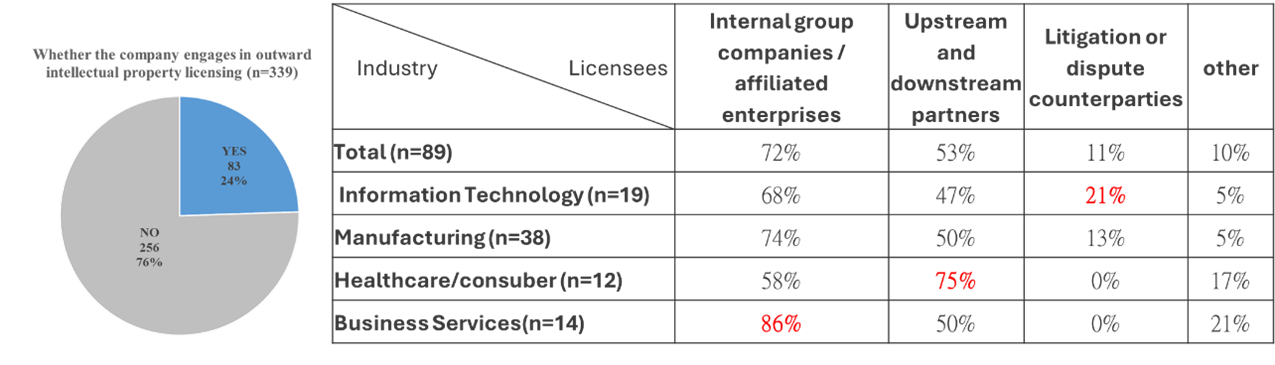
Data source: Innovation & Intellectual Property Center, Science & Technology Law Institute (STLI), Taiwan Intellectual Property Survey Report 2025.
Fig. 4 IP licensing
4. Strengthening IP Governance: Challenges of Trade Secrets and ESG Requirements
Survey respondents highlight several governance challenges:
● Trade secret management is regarded as highly important yet difficult, particularly due to supply-chain leakage risks, uncertainty regarding legal compliance, and evidentiary burdens in litigation.
● ESG integration presents new pressures, as firms struggle to articulate how IP contributes to sustainability performance.
● External verification challenges arise from inconsistencies in corporate governance standards and variable quality of third-party assessment services.
Conversely, two areas are widely viewed as “important but feasible”:
● Communicating IP value, including linkage to capital markets
● Commercializing university–industry collaborative research
These domains offer practical entry points for policy support and corporate capability-building.
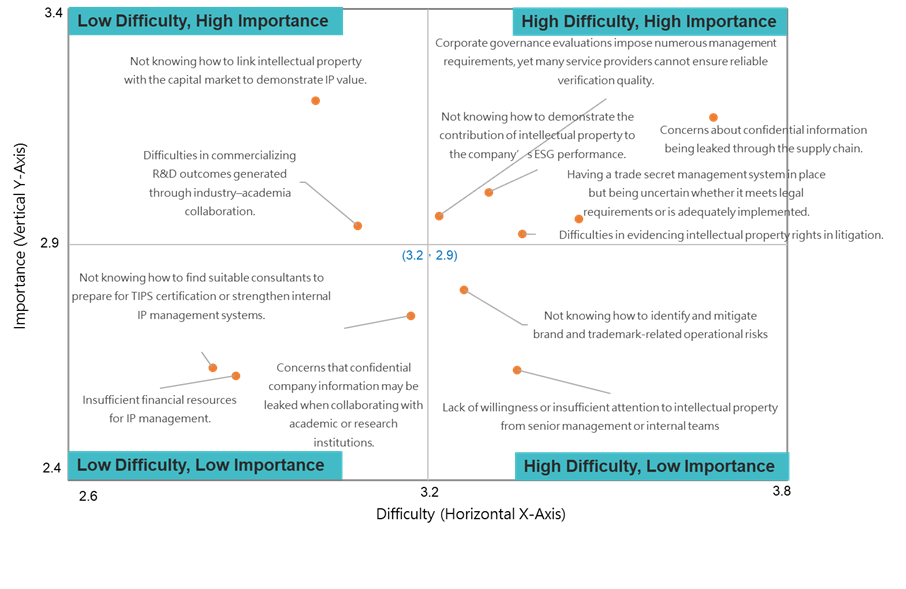
Data source: Innovation & Intellectual Property Center, Science & Technology Law Institute (STLI), Taiwan Intellectual Property Survey Report 2025.
Fig. 5 Challenges of IP management
5. Conclusion and Policy Implications
The 2025 survey demonstrates a decisive shift toward institutionalized, governance-oriented IP management in Taiwanese listed firms. Activities such as patent and trademark filing, trade secret identification, IP training, disclosure, and board-level reporting have all increased relative to 2023. As enterprises rely more heavily on trade secrets while simultaneously engaging in complex external collaborations, governance expectations and compliance pressures intensify. ESG-driven reporting further underscores the need for structured and evidence-based IP governance. Policy recommendations include:
1.Strengthening trade secret and supply-chain management tools through standardized audit frameworks, templates, and assessment mechanisms.
2.Developing IP–ESG disclosure guidelines and case studies to support consistent and meaningful reporting.
3.Expanding practical guidance and training on institutionalized IP governance to enhance firms’ capabilities in identification, internal control, access management, and value communication.
Together, these measures can support enterprise resilience and reinforce the role of IP governance within Taiwan’s sustainability and innovation ecosystem.
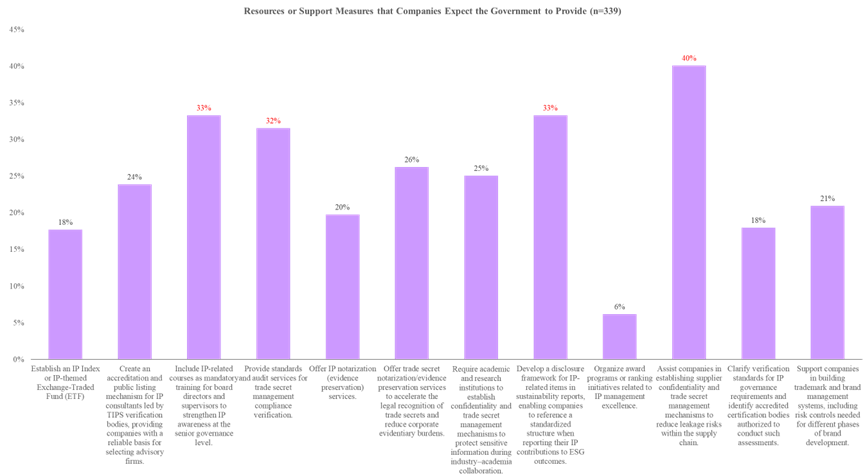
Data source: Innovation & Intellectual Property Center, Science & Technology Law Institute (STLI), Taiwan Intellectual Property Survey Report 2025.
Fig. 6 Policy recommendations
The complete survey report can be accessed in the Taiwan Intellectual Property Management System (TIPS) website. The download link is https://www.tips.org.tw/body.asp?sno=BGCHDC#460


Background Since 1990, many countries like United States, Japan and EU understand that intellectual properties create higher value added than tangible assets do so these countries respectively transformed their economic types to knowledge-based economy so as to boost economic growth and competitiveness. For example, Japan has legislated “Intellectual Property Basic Act” in 2002 and established “the Intellectual Property Strategy Headquarters” in 2003. United States legislated “Prioritizing Resources and Organization for Intellectual Property Act (PRO-IP Act)” in 2008. China also announced “National Intellectual Property Strategic Principles” in June, 2008. Following the above international tendency of protecting intellectual properties, Korea government has promoted intellectual property related policies and legislated related acts since 2000, such as “Technology Transfer Promotion Act” in 2000, policy of supporting patent disputes settlements and shortened the length of patent examination procedure in 2004. Besides, on June 27, 2006, the Presidential Advisory Council on Education, Science and Technology (PACEST) announced “Strategy for Intellectual Property System Constructing Plan.” However, these policies or acts mainly focus on the protection and application of patent rights, not relate to other kinds of intellectual property rights such as trademark right, copyright etc. Until 2008, in order to advance the ability of national competition, Lee Myung-bak government had established “Presidential Council on National Competitiveness (PCNC)”. For the vision of transforming to the intellectual property based economy, the PCNC held its 15th meeting on July 29, 2009. The meeting, held at the Blue House, was attended by the president, the Chairman, and members of the Council. One of the agenda of the meeting is strategies for an intellectual property (IP) powerhouse to realize a creative economy. Three goals of the strategies includes being IP Top 5 nations (U.S., Japan, EU, Korea and China), improving technology balance of payments deficits, and enhancing the scale of copyright industry. Next, this study will introduce details of Korea IP related strategies for our nation’s reference. Introduction Korea IP strategy consists of 3 aspects (creation and application, law and regulation, infrastructure) and 11 missions. And the contents of 11 missions cover the creation, protection and application of intellectual property rights (patent, copyright, trademark, plant variety etc), namely the whole life cycle of intellectual property rights. Through announcement of IP Strategies, Korea hopes to protect intellectual property rights from every aspect and makes IP as essential driving force for national economic growth. 1. Creation and Application Aspect First, although the quantity of intellectual property rights (IPRs) of Korea is rapidly increased in recent years, the quality of intellectual property rights is not increased equally. Also, most of researchers do not receive appropriate rewards from R&D institutions, and then it might reduce further innovation. As above reasons, Korea IP strategy indicated that the government will raise “invention capital” to exploit, buy researchers’ new ideas, and make those ideas get legal protection. That is, the government will set up non-practicing entities (NPEs) with private business. The NPEs would buy intellectual properties from R&D institutions or researchers, and then license to enterprises who have need. After licensing, NPEs will share royalty which obtained from enterprises (licensees) with researchers appropriately. Besides, in order to encourage university, public R&D institutions to set up “technology holdings”, Korea government had amended “Industry Education and Corporation of Industry, Academic and Research Promotion Act”. The amendments are loosening establishment conditions of technology holdings, such as minimum portion of investment in technology has been lowered from 50% to 30%, and broadening the scope of business of technology holdings. 2. Law and Regulation Aspect Secondly, in aspect of law and regulation, in addition to encouraging creation of good quality of IP, Korea considers that intellectual property rights are needed to be protected legally. Therefore, the IP strategy especially pointed out that Korea would follow the example of Japan to legislate their own “Intellectual Property Basic Act”. According to Korea “Intellectual Property Basic Act”, it should establish a “Presidential Council on Intellectual Property”. The main work of this Council is planning and promoting intellectual property related policies. There are 5 chapters and 41 articles in Korea “Intellectual Property Basic Act”. The Act like Korea IP strategy is divided into three parts, that is, “creation and application”, “protection” and “infrastructure”. In fact, the legislation of Korea “Intellectual Property Basic Act” embodies the policies of IP strategy. Further, according to Korea “Intellectual Property Basic Act”, “Presidential Council on Intellectual Property” is to integrate IP related affairs of the administrations into one action plan and promote it. Moreover, according to Korea “Intellectual Property Basic Act”, the government should make medium-term and long-term policies and basic plans for the promotion of intellectual properties every 5 years and adjusts policies and plans periodically as well. Through framing, enacting and adjusting policies and plans, Korea expects to create a well-living environment for the development of intellectual property. 3. Infrastructure Aspect Thirdly, even if good laws and regulations are already made and more government budget and human resource are invested, Korea is still deficient in well-prepared social infrastructure and leads to the situation that any promoting means of intellectual properties will be in vain. With regard to one of visions of Korea IP strategy,” being IP Top 5 power (U.S., Japan, EU, Korea and China)”, on the one hand, Korea domestic patent system should harmonize with international intellectual property regulations that includes loosening the conditions of application and renewal of patent and trademark. On the other hand, the procedure of patent application conforms to the international standard, that is, the written form of USA patent application becomes similar to the forms of world IP Top 3 power (U.S., Japan and EU) and member states of Paten Law Treaty (PLT). At the same time, Korea would join “Patent Prosecution Highway (PPH)” to enable Korea enterprises to acquire protection of patent rights around the world more rapidly. In addition, about the investigation of infringement of intellectual property rights, Korea IP strategy stated that it would strengthen control measures on nation border and broaden IP protection scope from only patent to trademark, copyright and geographical indications. Besides, Korea uses network technology to develop a 24-hour online monitoring system to track fakes and illegal copies. In addition to domestic IP protection, Korea enterprises may face IP infringement at overseas market, thus Korea government has provided supports for intellectual property rights disputes. For this sake, Korea choose overseas market such as Southeast Asia, China, and North America etc to establish “IP Desk” and “Copyright Center” for providing IP legal consultation, support of dispute-resolving expenses and information services for Korea enterprises. Korea IP strategy partially emphasizes on the copyright trading system As mentioned above, one of visions of Korea IP strategy is “enhancing the development of copyright industry”. It’s well-known that Korea culture industries like music, movie, TV, online game industries are vigorous in recent years. Those culture industries are closely connected to copyright, so development of copyright industry is set as priority policy of Korea. In order to enhance the development of Korea copyright industry, a well-trading environment or platform is necessary so as to make more copyrighted works to be exploited. Therefore, Korea Copyright Commission has developed “Integrated Copyright Number (ICN)” that is identification number for digital copyrighted work. Author or copyright owners register copyright related information on “Copyright Integrated Management System (CIMS)” which manages information of copyrighted works provided by the authors or copyright owners, and CIMS would give an ICN number for the copyrighted work, so that users could through the ICN get license easily on “Copyright License Management System (CLMS)” which makes transactions between licensors and licensees. By distributing ICN to copyrighted works, not only the licensee knows whom the copyright belongs to, but the CLMS would preserve license contracts to ensure legality of the licensee’s copyright. After copyright licensing, because of characteristic of digital and Internet, it makes illegal reproductions of copyrighted works easily and copyright owners are subject to significant damages. For this reason, Korea Ministry of Culture, Sports and Tourism (MCST) and Korea Intellectual property Office (KIPO) have respectively developed online intellectual property (copyright and trademark) monitoring system. The main purpose of these two systems is assisting copyright and trademark owners to protect their interests by collecting and analyzing infringement data, and then handing over these data to the judiciary. Conclusion Korea IP strategy has covered all types of intellectual properties clearly. The strategy does not emphasize only on patent, it also includes copyright, trademark etc. If Taiwan wants to transform the economic type to IP-based economy, like Korea, offering protection to other intellectual property rights should not be ignored, too. As Taiwan intends to promote cultural and creative industry and shows soft power of Taiwan around the world, the IP strategy of Taiwan should be planned more comprehensively in the future. In addition to protecting copyrights by laws and regulations, for cultural and creative industry, trading of copyrights is equally important. The remarkable part of Korea IP strategy is the construction of copyright online trading platform. Accordingly, Taiwan should establish our own copyright online trading platform combining copyright registration and source identification system, and seriously consider the feasibility of giving registered copyright legal effects. A well-trading platform integrating registration and source identification system might decrease risks during the process of licensing the copyright. At the same time, many infringements of copyrights are caused because of the nature of the modern network technology. In order to track illegal copies on the internet, Taiwan also should develop online monitoring system to help copyright owners to collect and preserve infringement evidences. In sum, a copyright trading system (including ICN and online intellectual property monitoring system) could reinforce soft power of Taiwan cultural and creative industry well.
DJSI x TIPS: STLI Supports Enterprises in Optimizing IP Management to Achieve ESG-Oriented Sustainable Operations Through Promoting Taiwan Intellectual Property Management System (TIPS)DJSI x TIPS: STLI Supports Enterprises in Optimizing IP Management to Achieve ESG-Oriented Sustainable Operations Through Promoting Taiwan Intellectual Property Management System (TIPS) 2025/05/21 With the global push for sustainable development, the connection between Intellectual Property (IP) and Environmental, Social, and Governance (ESG) considerations has become increasingly significant. Leading economies such as the World Intellectual Property Organization (WIPO), the United States, the European Union, and Japan have all incorporated IP policy into their ESG development strategies to drive green innovation and reinforce corporate social responsibility. Taiwan is actively responding to this global trend. In addition to transforming its Corporate Governance Evaluation into an ESG Evaluation by 2026, adjustments are also being made at the policy level. Government agencies such as the Taiwan Intellectual Property Office (TIPO) have introduced resources like the "Green Trademark Analysis" and "Green Technology Patent Analysis" to support enterprises in integrating ESG strategies with IP management. Furthermore, the Science & Technology Law Institute (STLI) of the Institute for Information Industry has been promoting the Taiwan Intellectual Property Management System (TIPS), urging enterprises to connect IP management with ESG principles to enhance their sustainability practices. As IP management becomes a critical element in sustainable development and evaluation systems, enterprises are encouraged to actively engage with these policy tools to strengthen their ESG performance and global competitiveness. Promotion of TIPS and 2025 Award Ceremony The Industrial Development Administration (IDA) of the Ministry of Economic Affairs commissioned the Science & Technology Law Institute (STLI) of the Institute for Information Industry (III) to promote the Taiwan Intellectual Property Management System (TIPS). On February 20th, the 2025 TIPS Award Ceremony and Special Seminar on IP Management and ESG Integration was held at the Center for Public and Business Administration Education National Chengchi University, where Deputy Director-General Yu-Hsin Tsou awarded TIPS certification certificates to 91 enterprises that passed the verification in 2024, including Taiwan Semiconductor Manufacturing Company Limited (TSMC), United Microelectronics Corporation (UMC), Yulon Motor Co., Ltd., Vanguard International Semiconductor Corporation, Sino-American Silicon Products Inc., and Yuanta Futures Co., Ltd.—companies that have ranked in the top 5% for corporate governance for 11 consecutive terms—demonstrating that intellectual property management contributes to enhanced corporate governance performance. Phote source: Photos from the 2025 TIPS Award Ceremony and Special Seminar on IP Management and ESG Integration, Innovation & Intellectual Property Center, Science & Technology Law Institute (STLI). TIPS Certification Reaches Record High, Nearly 80% of Certified Companies Listed in the DJSI World Index and the DJSI Emerging Markets Index Deputy Director General Tsou stated that the number of companies passing TIPS certification in 2024 has reached a new high of 140. Companies certified under TIPS not only perform excellently in Corporate Governance Evaluation but also stand out in ESG-related performance rankings. In 2024, nearly 80% of the Taiwanese enterprises listed in the Dow Jones Sustainability World Index (DJSI World Index) and the Dow Jones Sustainability Emerging Markets Index (DJSI Emerging Markets Index) have obtained certification under the Taiwan Intellectual Property Management System (TIPS). Adapting to International Trends: Aligning Corporate Governance with ESG In response to the global emphasis on ESG and sustainable development, companies are encouraged to enhance sustainable operations through improved corporate governance. At this award ceremony, special seminars were given by Director Chen-Shan Chang of the Securities and Futures Bureau, Financial Supervisory Commission (FSC), Deputy Director Chun-Chieh Lai of the Bureau of Standards, Metrology and Inspection, Ministry of Economic Affairs (MOEA), and Director Cheng-Wei Liao of the Taiwan Intellectual Property Office (TIPO), Ministry of Economic Affairs (MOEA). Securities and Futures Bureau: Guiding Companies to Explore and Implement a Dual-Track Strategy IP and ESG through ESG Evaluation The Securities and Futures Bureau outlined its plan to transition the Corporate Governance Evaluation into the ESG Evaluation by 2026, highlighting the connection between corporate governance and sustainable development, as well as the policy rationale behind the shift. It also introduced the structure of the forthcoming ESG evaluation, including the principles of indicator design and their strategic underpinnings. The Bureau noted that companies currently participating in the governance evaluation are predominantly part of corporate groups, which often lead efforts to emphasize intellectual property (IP) management. Companies with stronger ESG performance are likewise more likely to view IP as a strategic asset. Based on these findings, the Bureau encouraged enterprises to strategically integrate IP management into their ESG frameworks to generate synergy through a dual-track approach, while also advocating for enhanced ESG-related information disclosure to strengthen sustainable operations, and recommending the acquisition of TIPS (Taiwan Intellectual Property Management System) certification to showcase ESG strengths. Bureau of Standards: Effectively Utilizing Management Standards to Accelerate the Implementation of ESG Sustainability Management in Enterprises The Bureau of Standards advised that, in the course of implementing ESG (Environmental, Social, and Governance) through management systems such as ISO, companies should exercise due diligence in verifying whether the engaged training or certification bodies have been accredited by competent authorities or credible independent third-party organizations, so as to ensure the credibility and substantive effectiveness of their ESG performance and to prevent potential challenges to its legitimacy. Intellectual Property Office: Understanding the Key Points of IP and ESG Integration through Global Policy Trends, including Green Patents and Green Trademarks The Intellectual Property Office actively highlighted how international policy frameworks are increasingly integrating intellectual property with environmental (E) and social (S) aspects. For example: In April 2024, the World Intellectual Property Organization (WIPO) published Mapping Innovation: Patents and the Sustainable Development Goals, which found that 13 out of the 17 Sustainable Development Goals (SDGs) are associated with relevant patent technologies. The United States Patent and Trademark Office (USPTO) has promoted the "Patents for Humanity Award" since 2013 and launched the "Trademarks for Humanity Award" in 2024to recognize innovators who leverage patents and trademarks to tackle challenges related to energy, the environment, and climate change. Japan’s Patent Office (JPO) released a Green Transformation Technology Classification List in June 2022 to guide green innovation. In recent years, the Taiwanese Intellectual Property Office (TIPO) has responded to international trends by increasingly emphasizing green patents and green trademarks in its policies, and has provided tools such as the "Taiwan Green Trademark Analysis" and "Green Technology Patent Analysis." During seminars, it has shared practical cases from well-known companies like Apple and TSMC, demonstrating how green patents and trademarks can be integrated into ESG strategies. As a result, the TIPO encourages companies to leverage both domestic and international resources to strategically align intellectual property with ESG objectives, using green patent and trademark portfolios to protect ESG-driven innovation and build sustainable brands. Science & Technology Law Institute: Exploring New Approaches to Trade Secret Protection and Capital Market Integration through the Concept of IP ETFs Finally, Deputy Director Tsung-Hsuan Tsou of the Science & Technology Law Institute at the Institute for Information Industry stated that, in response to the 2026 transition from Corporate Governance Evaluation to ESG Evaluation, and given that trade secret protection and supply chain management have become critical for companies facing global competition and pursuing sustainable development, the Institute will continue to guide enterprises in accordance with the TIPS intellectual property management framework to strengthen trade secret protection and supply chain management and to align with international trends; furthermore, it will promote the integration of intellectual property with capital markets, for example, by developing Intellectual Property Exchange-Traded Funds (IP ETFs) to provide enterprises with new perspectives on value creation and investment decision-making.
The Demand of Intellectual Property Management for Taiwanese EnterprisesScience & Technology Law Institute (STLI), Institute for Information Industry has conducted the survey of “The current status and demand of intellectual property management for Taiwanese enterprises” to listed companies for consecutive four years since 2012. Based on the survey result, three trends of intellectual property management for Taiwanese enterprises have been found and four recommendations have been proposed with detail descriptions as below. Trend 1: Positive Growth in Intellectual Property Awareness and Intellectual Property Dedicated Department/Personnel, Budget and Projects 1.Taiwanese enterprises believe that intellectual property plays an important role 74.18% of Taiwanese enterprises believe that intellectual property can increase economic value and 58.61% of those believe that it can effectively prevent competitors from entering the market. Source: created by project team members Graph 1 The benefit of intellectual property for the company 2.Taiwanese enterprises increase investment in the dedicated department and full time personnel for intellectual property Nearly 80% of listed and OTC companies set up full time personnel for intellectual property and over 50% of those have established dedicated department to handle its business that is higher than 30% in 2012. Source: created by project team members Graph 2 Specialized Department or personnel for intellectual property by year 3.Taiwanese enterprises plan budget for intellectual property each year 81% of respondent companies plan certain budget for intellectual property each year. Among the expenses items, the percentage of 90.95% for intellectual property application is the highest. Next are 58.29% for inventor bonus payment and 56.28% for intellectual property education training. Source: created by project team members Graph 3 Taiwanese enterprises plan budget for intellectual property each year Trend 2: Insufficient Positive Activation for Intellectual Property 1.Interior intellectual property personnel is seldomto be involved in the core decision making in Taiwanese enterprises Based on the importance and difficulty of intellectual property, most items in the area of high importance and difficulty are demand of professionals and practical experiences (e.g.: lack of interior talent, do not understand international technology standard and specification, lack of platform to obtain experiences and cases). Only application time is for administrative procedure of Intellectual Property Offices. Therefore, it is known that intellectual property department of respondent companies lacks experienced talents. Source: created by project team members Graph 4 Importance and difficulty of intellectual property In addition, most of the jobs of intellectual property personnel are “keeping close cooperation and communication with R&D department”, “coordinating issues relevant to intellectual property between departments” and “keeping close cooperation and communication with marketing or sales department” instead of “R&D strategy involvement” and “marketing and operation strategy involvement” (see Graph 5). Therefore, it is demonstrated that the work of intellectual property personnel is mainly for providing coordination and assistance to other departments other than corporate strategy with intellectual property as basis. Maybe it is the reason for insufficient activation and lower investment of intellectual property in the business. Source: created by project team members Graph 5 The job of intellectual property department or personnel 2.Insufficient positive activation for intellectual property in Taiwanese enterprises It is shown that 60% of firms are without and did not obtain technology transfer (among which the traditional manufacturing sector has the highest percentage). 22.95% of firms are without but obtained technology transfer and 4.51% of those are with but did not obtain technology transfer. In addition, most of the jobs of intellectual property are administration other than activation such as treatment of authorization contract and transaction and sending warning letter of infringement. Therefore, it is assumed that intellectual property is not the key for profitability in the business. 3.Taiwanese enterprises with higher R&D expenses ratio intend to have more positive activation of intellectual property Although the entire firms are not positive for activation of intellectual property, it is found that enterprises with higher R&D expenses ratio (the ratio of R&D expenses / total operating expenses is higher than average) intend to have more positive activation of intellectual property. For example, intellectual property department with higher R&D expenses ratio involves more in the decision making of R&D strategy in the business. Compared with the enterprises with higher R&D expenses ratio, the enterprises with lower R&D expenses ratio also has higher ratio in the absence and failure of technology transfer. (see Graph 6) Source: created by project team members Graph 6 Presence and achievement of technology transfer in the different sector 4.Most of Taiwanese enterprises R&D on their own so to lack of introduction experience of external R&D results Among the survey, nearly 90% of firms R&D each item on their own except the copyright part with lower percentage of 78.5%. 15.89% of it is from outsourcing development and 13.08% of it is from authorization. In addition, the outsourcing development and authroization of invention patent part have higher percentage which is 17.34% and 15.61% respectively. However, the speed of self R&D can’t meet the speed of product elimination nowadays. Therefore, under global open competition, corporate may try to cooperate with universities and research institutions to speed up R&D progress. Table 1 Source of Intellectual Property Right Source: created by project team members Further, among the services s that corporate ask for assistance from government, there are high demand for promotion of cooperation between industrial, academic and research sectors as well as assistance provided by academic and research institution to enhance corporate’s R&D ability. Based on this, it is clear established that a smooth access can help enterprises to cooperate with academic and research institutions for R&D instead of doing it on their own. Source: created by project team members Graph 7 The Government Policy for Intellectual Property 5.Taiwanese enterprises focus only on patent and trademark but ignore trade secret and copyright From the intellectual property items enterprises possessed each year, it is found that trademark has the highest percentage (over 80% for four-year average) and next items are invention patent and utility model patent. The awareness that corporates have on intellectual property is only limited to patent and trademark. They overlook that their core ability may be protected by trade secret and copyright. Source: created by project team members Graph 8 Owned IP right Trend 3: Increasing Demand on International Intellectual Property Service 1.The overseas intellectual property risk Taiwanese enterprises faced greatly varies from sectors Among the 2015 survey, 85% of respondent firms developed to overseas. Under which the highest percentage is 79.81% for overseas sale then 56.25% for self-establishment of overseas factory for manufacturing. Furthermore, the percentage of outsourcing in traditional manufacturing sector is the highest than that of other industries which 77.36% of traditional manufacturing firms established overseas factory for manufacturing. The percentage of overseas sale in pharmaceutical and livelihood sector is 91.3% and slightly higher than that in other industries. The result shows that different industry will select different overseas development strategy based on its sector characteristics and R&D difficulty. Source: created by project team members Graph 9 The overseas intellectual property risk As a whole, the highest risk that might be occurred from enterprises developed overseas is leakage of trade secrets. Next risks are 47.12% for being accused of product infringement and 42.31% for patent being registered. Further, the risk control greatly varies from different sector. The risks that industry and commerce service sector regards are quite different from other sectors. For example, its risk of dispute of employee jumping ship or being poached which accounted for 50% is higher than that of other sectors. In addition to the three common risks mentioned above, information and technology sector believes that there might be risk of patent dispute which accounted for 35.29% and is higher than that of other sectors. Source: created by project team members Graph 10 The overseas risk control which might be occurred by enterprises 2.The most dissatisfied part that Taiwanese enterprises have to the intellectual property outsourcing service is insufficient experiences on the treatment of international affairs Based on the 2012 and 2013 data, the too expensive fees is the primary factor that intellectual property outsourcing service didn’t meet the demand. However, from the 2014 and 2015 survey result, the experiences on the treatment of international affairs became the primary factor. It is shown that enterprises increase demand for international intellectual property work but current services from providers can’t satisfy it. From survey data, it is found that different sector has different demand on overseas development. Among which the pharmaceutical and livelihood sector has higher demand on the management of overseas trademark use, investigation of overseas infringement risk, contract of overseas patent authorization, contract of overseas trademark authorization, contract of overseas technology transfer and contract of overseas mutual R&D (See Graph 11). Source: created by project team members Graph 11 The outsourcing professional resources unsatisfied with demand – annual comparision Recommendation 1: Taiwanese enterprises shall build intellectual property creation strategy based on a variety of intecllectual property rights Enterprises may apply for patent, trademark, trade secret and copyright. For instance, brand management can be conducted with trademark and copyright and core technology or service can be protected by patent and trade secret instead of using trademark or patent alone as primary strategy. Recommendation 2: Provide Taiwanese enterprises with assistance of overseas intellectual property consultation 85% of respondent firms have overseas business which greatly varies from different sector so to accompany with different overseas intellectual property risk. Therefore, government may provide enterprises with the information of overseas intellectual property and even real time consultation services of overseas intellectual property risk which is the requirement to be satisfied immediately. In addition, the actual overseas intellectual property demand of enterprises can be found through this introduction of consultation services. To satisfy enterprises’ demand, service providers may need to improve their ability together. Recommendation 3: Build cooperation access of industry, academics and research to assist Taiwanese enterprises to enhance R&D ability Under the fast-evolved and competitive environment, enterprises shall not only depend on their own R&D. Moreover, they shall leverage the R&D result of academic and research institutions to improve so to make subsidy of those institutions from government have real impact on them. Therefore, there is demand of cooperation between industry, academics and research. The cooperation access between them should be built to achieve synergy of R&D. Recommendation 4: Experienced professionals of intellectual property are requried to be cultivated and demand of intellectual property human capital is needed to be expanded for Taiwanese enterprises Enterprises lack of experienced professionals of intellectual property. This demand could be satisfied only through on-the-job training for large personnel other than new graduates of department of intellectual property. Furthermore, enterprises can make department of intellectual property contribute its professional services into R&D and marketing strategy through design of organization work procedure to reduce risk of intellectual property they have to face.
From Ownership to Governance: Trade Secret Management Trends among Taiwanese Listed CompaniesFrom Ownership to Governance: Trade Secret Management Trends among Taiwanese Listed Companies 2026/06/18 Since 2013, the Innovation & Intellectual Property Center of the Science & Technology Law Institute (STLI), Institute for Information Industry (III), has conducted a biennial survey on the status and needs of intellectual property (IP) management among Taiwanese listed and over-the-counter companies. The 2025 survey collected valid responses from 339 listed companies. The results reveal several notable trends that differ from previous survey waves and collectively indicate that corporate IP management in Taiwan is moving toward institutionalized and governance-oriented practices. This article focuses on findings related specifically to trade secret management, with key observations summarized as follows. 1. A Rising Share of Companies Reporting Trade Secrets, Reflecting a Shift toward Confidentiality-Based Protection The 2025 survey shows that 51% of companies report owning trade secrets. Compared with the 2023 survey, trade secrets are the only IP category showing a slight increase, while the shares of trademarks, patents, and copyrights have all declined marginally. This trend indicates that companies are increasingly relying on trade secrets to protect critical technologies, data, and operational information as part of their IP portfolios. Such a shift reflects practical business realities, including rapid R&D cycles, shortened product lifecycles, and the difficulty of fully protecting certain technologies through patent disclosure. Under these conditions, trade secrets have become a highly relied-upon protection mechanism in corporate practice. Data source: Innovation & Intellectual Property Center, Science & Technology Law Institute (STLI), Taiwan Intellectual Property Survey Report 2025. Fig. 1 owned Various Intellectual Properties 2. Increased Identification of Trade Secrets, but Effective Protection Still Depends on Internal Management Capabilities An examination of corporate IP management activities reveals that, as companies place greater emphasis on trade secrets, the proportion of firms conducting trade secret identification and inventorying has increased markedly between 2023 and 2025. This development suggests that companies are increasingly aware that only through systematic identification can trade secret subject matter (TS assets) be clearly defined, thereby enabling subsequent measures such as classification, access control, employee training, and external disclosure management. It is important to note, however, that while trade secret-related schemes or registration mechanisms may provide incentives and structural frameworks for companies to initiate management efforts, effective protection ultimately depends on firms’ own capabilities. Specifically, companies must be able to independently identify trade secrets, maintain updated inventories, and continuously manage TS assets. In other words, external mechanisms can encourage companies to engage with trade secret issues, but the core of trade secret governance lies in internal identification and ongoing management of TS assets. Data source: Innovation & Intellectual Property Center, Science & Technology Law Institute (STLI), Taiwan Intellectual Property Survey Report 2025. Fig. 2 Increased Identification of Trade Secrets: 2023 and 2025 report 3. High Perceived Importance of Trade Secrets, Yet a Persistent Gap between Importance and Actual Implementation Although the proportion of companies reporting ownership of trade secrets has increased slightly since 2023, the survey shows that the perceived importance of trade secrets remains significantly higher than actual ownership and implementation levels. This gap suggests that while many companies recognize the strategic importance of trade secrets for competitiveness, they often lack the institutional designs and operational practices needed to support that recognition. Such gaps include deficiencies in identification procedures, unclear allocation of management responsibilities, and insufficient internal and external control measures. The result is a structural issue characterized by high awareness but incomplete implementation. Data source: Innovation & Intellectual Property Center, Science & Technology Law Institute (STLI), Taiwan Intellectual Property Survey Report 2025. Fig. 3 Owned and Importance of Various Intellectual Properties 4. Trade Secrets as the Primary Source of IP Risk, with Key Challenges in Leakage Prevention and Legal Proof In terms of IP risk perception, trade secrets have become the most significant concern for companies. The risks that companies believe they are most likely to encounter include: ● Misappropriation of company trade secrets by others (60%) ● Infringement of company trademark rights by others (56%) ● Infringement of company patent rights by others (50%) ● Infringement of others’ patent rights by the company (50%) ● Trademark squatting against the company (47%) Data source: Innovation & Intellectual Property Center, Science & Technology Law Institute (STLI), Taiwan Intellectual Property Survey Report 2025. Fig. 4 IP Risk From a management perspective, the top three trade secret–related concerns are: ● 76% worry that information shared with external partners may be improperly used; ● 67% worry about data leakage; ● 58% worry about the inability to detect data leakage in a timely manner. In addition, companies express strong concern about whether their trade secrets would be recognized by courts as meeting the statutory requirements in the event of litigation. Among the three legal requirements for trade secret protection, “reasonable confidentiality measures” are perceived as the most difficult to satisfy (87%), whereas only about half of the respondents believe that “secrecy” and “economic value” can be adequately demonstrated. This finding highlights persistent gaps in both institutional implementation and evidentiary capability.。 Data source: Innovation & Intellectual Property Center, Science & Technology Law Institute (STLI), Taiwan Intellectual Property Survey Report 2025. Fig. 5 Challenges in Leakage Prevention and Legal Proof 5. Expanded Trade Secret Control Requirements in External Collaboration Contexts With respect to external collaboration, 48% of companies report the need to provide or share important (confidential) information with external parties, with the highest proportion observed in the healthcare and life sciences sector (66%). Most collaboration partners are private enterprises (87%), followed by academic, legal entity, or government research institutions (46%). Data source: Innovation & Intellectual Property Center, Science & Technology Law Institute (STLI), Taiwan Intellectual Property Survey Report 2025. Fig. 6 Sharing of confidential information with external partners When collaborating with private enterprises, companies primarily rely on written agreements as control measures, including confidentiality and IP ownership clauses (99%) and requirements for data return or destruction after use (55%). Requirements imposed on external corporate partners focus mainly on having their personnel sign confidentiality agreements (74%) and implementing access control mechanisms (69%). Data source: Innovation & Intellectual Property Center, Science & Technology Law Institute (STLI), Taiwan Intellectual Property Survey Report 2025. Fig. 6 Required controls: shared with private enterprises By contrast, when collaborating with academic or research institutions, companies impose even more extensive control requirements, despite adopting broadly similar management approaches. In addition to confidentiality and IP ownership agreements (97%), companies more frequently require data identification (60%), access control (63%), and training measures (21%). This reflects a widespread perception that academic and research institutions generally have less mature trade secret management systems and organizational cultures, necessitating additional safeguards. Fig. 6 Required controls: shared with academic and research institutions 6. Conclusion: From Identified Challenges Back to Practical Governance Frameworks Overall, the 2025 survey indicates that corporate awareness of trade secret importance and associated risks has increased substantially. Nevertheless, companies continue to face significant challenges in trade secret identification, institutional implementation, external collaboration controls, and litigation-related proof. These challenges underscore the need for institutionalized guidance and practical management tools in trade secret governance. In this regard, companies may refer to the Trade Secret Protection and Management Guidelines (https://stli.iii.org.tw/publish-detail.aspx?no=72&d=7212) issued by the Science & Technology Law Institute, III, which provide concrete frameworks and practical recommendations for both internal management and external collaboration controls. In addition, STLI’s forthcoming publication, From Management Measures to Case Analysis: A Comprehensive Review of Trade Secret Management in Academia–Industry Collaboration (https://stli.iii.org.tw/publish.aspx?no=58), will offer systematic analysis and case-based insights into trade secret risks and management practices in collaborations between companies and academic or research institutions. Together, these resources serve as important practical references for building effective trade secret management systems in both corporate and academic contexts. The complete survey report can be accessed in the Taiwan Intellectual Property Management System (TIPS) website. The download link is https://www.tips.org.tw/body.asp?sno=BGCHDC#460
- The amendment of the Taiwanese Personal Data Protection Act
- Impact of Government Organizational Reform to Scientific Research Legal System and Response Thereto (1) – For Example, The Finnish Innovation Fund (“SITRA”)
- Legal issues of Third-Party Payment in Taiwan
- The Demand of Intellectual Property Management for Taiwanese Enterprises
- Recent Federal Decisions and Emerging Trends in U.S. Defend Trade Secrets Act Litigation
- Blockchain in Intellectual Property Protection
- Impact of Government Organizational Reform to Research Legal System and Response Thereto (2) – Observation of the Swiss Research Innovation System
- Taiwan's Approach to AI Governance